Every child who falls in love with reading usually remembers a specific book: the picture book with colors so bright they seemed to jump off the page, the comic with crisp panels that made the action feel alive, or the workbook that held up through months of pencil marks and page-turning. Behind each of these experiences sits a process most readers never think about: children’s book printing. Producing books for kids takes more than running pages through a press. It takes the right printing technology, carefully chosen materials, precise finishing, and consistent quality control from the first page to the last.
Children interact with books differently than adults do. They notice bright colors, follow illustrations closely, flip back and forth between pages, trace letters with their fingers, and sometimes chew on corners. A textbook, storybook, or coloring book has to survive all of that while still looking sharp and reading clearly. That’s why children’s book printing and manufacturing deserves more attention than it usually gets; the quality of the physical book shapes how a child learns, plays, and falls in love with reading.
What Is Children’s Book Printing & Manufacturing?
People often use “printing” and “book manufacturing” as if they mean the same thing, but they describe different parts of the same journey. Printing refers to the actual transfer of ink (or toner) onto paper. Book manufacturing covers everything that happens before and after that step — turning printed sheets into a finished, bound, ready-to-ship product.
A typical children’s book moves through several connected stages:
Design → Pre-Press → Printing → Cutting → Folding → Binding → Finishing → Quality Control → Packaging
In the design stage, illustrators, authors, and layout designers build the pages exactly as they should appear in print. Pre-press checks that the files are print-ready, correct color profiles, resolution, bleed, and margins. Printing applies ink to paper using offset or digital presses, depending on the run size. Cutting and folding shape the printed sheets into the correct page order and trim size. Binding holds the pages together using methods such as saddle-stitching, perfect binding, or board binding. Finishing adds lamination, spot UV, or coatings that protect the cover. Quality control inspects color accuracy, alignment, and durability before packaging and dispatch sends the finished books out the door.
Understanding this flow helps schools, publishers, and independent authors ask better questions when choosing a book printing company, because each stage affects the final product in a different way.
What Types of Books for Kids Can Be Printed?
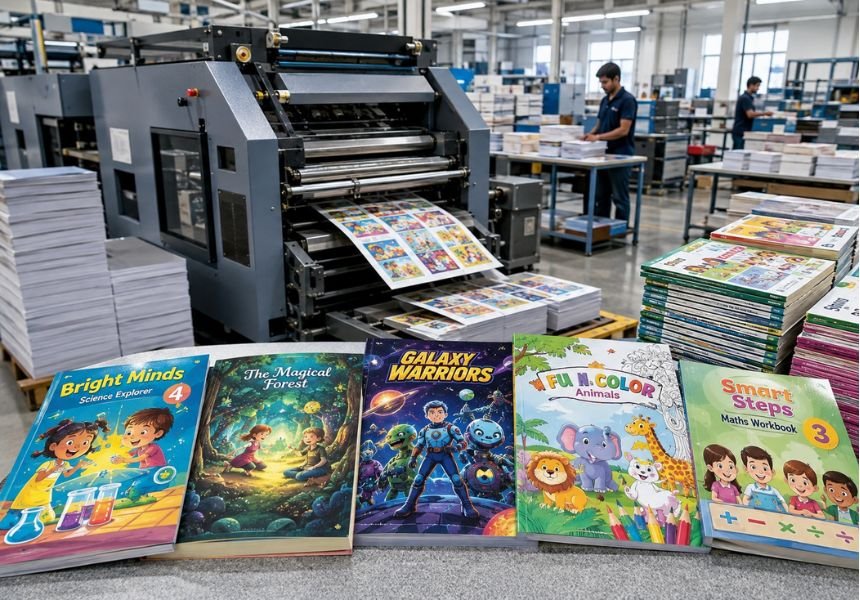
Children’s publishing covers a wide range of formats, and each one has its own printing requirements.
School Textbooks
Textbooks need clear, legible text, accurate diagrams, and illustrations that withstand daily handling. Because these books are often reprinted year after year, consistent printing across large volumes matters just as much as first-run quality. Durable paper stock and reliable binding are essential, since textbooks are opened and closed hundreds of times over a school year.
Educational & Learning Books
Alphabet books, early mathematics books, phonics readers, and general knowledge titles rely on precise typography and clean layouts. Young readers are still learning to recognize letters and shapes, so even small printing inconsistencies blurry type, uneven spacing, or dull colors can make learning materials harder to use.
Comics & Graphic Books
Comic book printing depends heavily on color accuracy and image sharpness. Detailed illustrations, panel borders, and speech bubbles need to reproduce cleanly at whatever trim size the publisher chooses. Vibrant, consistent color across every copy in a print run is what separates a professional comic from an amateur one.
Storybooks & Picture Books
Storybook printing lives and dies by image quality. Illustrations carry as much of the story as the text does, so accurate color reproduction, sharp detail, and quality paper directly shape how a child experiences the book. A washed-out illustration or muddy color mix can flatten an otherwise beautiful story.
Coloring & Activity Books
Coloring book printing calls for paper that can absorb crayons, markers, or colored pencils without bleeding through to the next page. Line clarity matters too; thin, broken outlines are frustrating for small hands to color inside. Page durability is important since these books tend to get heavy use in a short period.
Workbooks & Practice Books
Workbook printing needs writing-friendly paper that doesn’t smudge with pencil or feather with ink, along with binding strong enough to survive being opened flat on a desk repeatedly. Because workbooks are used for repeated practice, the layout also needs enough space for a child to write comfortably.
Other children’s publications puzzle books, early readers, board books, and educational flashcard sets follow similar principles: the paper, binding, and finishing should match how the child will actually use the book.
The Children’s Book Printing Process
A complete book manufacturing project moves through several stages, each with its own purpose.
- Manuscript and artwork preparation: Text and illustrations are finalized and formatted to the correct trim size and bleed requirements.
- Pre-press and file checking: Files are reviewed for resolution, color mode, fonts, and layout errors before anything goes to press.
- Color management: Color profiles are calibrated so illustrations print consistently from the first copy to the last.
- Printing: Offset presses handle large runs efficiently, while digital printing suits smaller or custom orders.
- Paper selection: Paper weight, brightness, and finish are chosen based on the book type, whether that’s a sturdy board book or a workbook that needs to take pencil marks well.
- Cutting and folding: Large printed sheets are cut and folded into signatures, the multi-page sections that form the book’s interior.
- Binding: Saddle-stitching suits thinner books like comics and activity books, while perfect binding or board binding suits thicker storybooks and textbooks.
- Finishing: Covers receive lamination, spot UV, or embossing to improve durability and shelf appeal.
- Quality inspection: Every batch is checked for color accuracy, page alignment, binding strength, and overall consistency.
- Packaging and dispatch: Finished books are packed to prevent damage in transit and shipped to schools, publishers, or distributors.
Each stage builds on the one before it, which is why a single weak link — poor color calibration, the wrong paper stock, or rushed binding can affect the entire print run.
Why Printing Quality Matters for Children’s Books
Print quality isn’t just a visual preference in children’s publishing it directly affects how well a book works.
- Vibrant and accurate colors keep illustrations engaging and true to the artist’s original intent
- Sharp illustrations help young readers follow visual storytelling without confusion
- Easy-to-read typography supports early literacy and reduces eye strain
- Durable pages survive repeated handling, spills, and the general wear that comes with young readers
- Strong binding keeps pages from falling out after weeks of daily use
- Appropriate paper selection prevents ink bleed-through and supports writing or coloring activities
- Safe, professional finishing avoids sharp edges or materials unsuitable for children
- Consistent quality across large print runs ensures every classroom or bookstore copy matches
These factors connect directly to a child’s actual experience with the book, whether that’s following a story, completing a worksheet, or coloring inside the lines. A well-manufactured book supports learning; a poorly made one gets in the way of it.
How Modern Printing Machines Improve Children’s Books
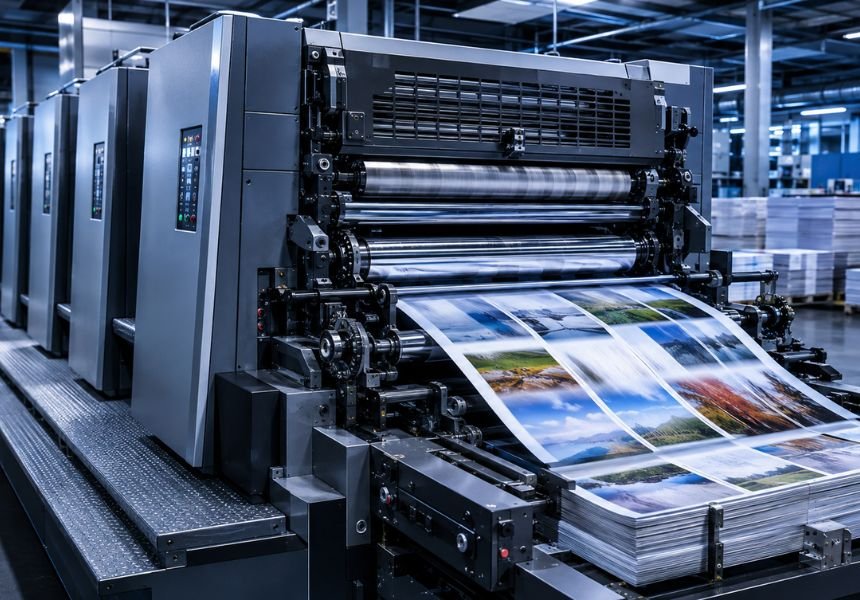
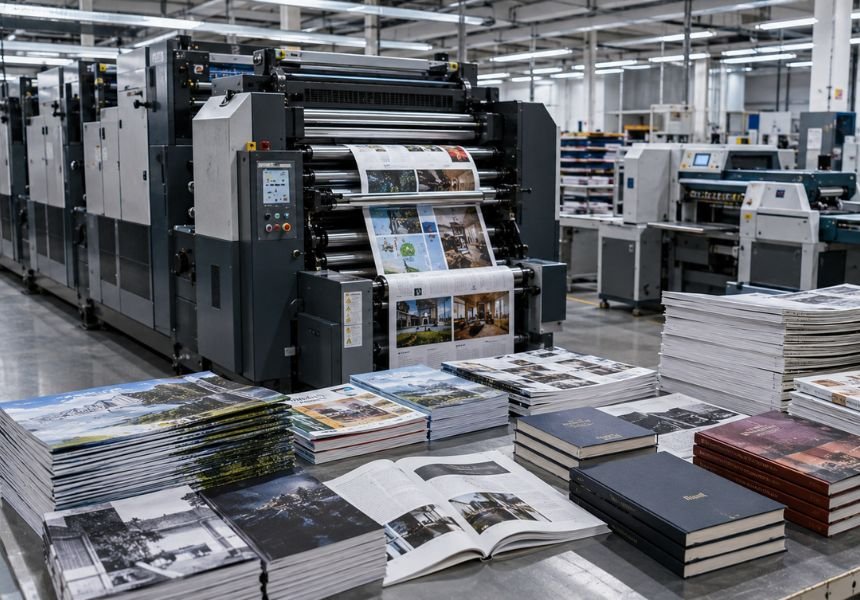
Modern printing machinery has changed what’s possible in children’s book manufacturing. Professional production equipment helps achieve consistent print quality across thousands of copies, accurate color matching from the first sheet to the last, and high-resolution reproduction of detailed illustrations.
Faster production cycles mean publishers and schools can meet tighter deadlines without compromising on quality, and large-volume printing capacity supports everything from a single classroom set to a nationwide textbook rollout. Reliable repeat orders are especially important for schools that need matching textbooks year after year, since even small color or paper shifts can create an inconsistent set.
Professional finishing equipment adds lamination, coatings, and binding with a precision that’s difficult to achieve by hand, and better production efficiency keeps costs manageable even on large or complex orders. Printing facilities equipped with modern machinery can manufacture children’s books at scale while still maintaining the attention to detail that younger readers’ books require.
Printing Books for Schools, Publishers & Children’s Brands
Children’s book printing supports a wide range of organizations, each with different needs:
- Schools ordering textbook sets or workbooks for an entire grade level
- Educational publishers producing curriculum-aligned learning materials
- Children’s book publishers releasing storybooks and picture books
- Independent authors self-publishing a picture book or early reader
- Comic creators producing single issues or bound collections
- Educational organizations and NGOs distributing literacy materials
- Training companies producing workbooks for youth programs
- Children’s brands creating branded activity or coloring books
Each project can call for a different combination of paper type, trim size, binding style, finish, and print quantity. A school textbook order might prioritize durability and cost efficiency across thousands of copies, while a picture book publisher might prioritize color accuracy and premium paper for a smaller run. A good printing partner adjusts its process to match the project rather than applying one approach to everything.
From School Books to Comics: What Can Be Manufactured?
Children’s book manufacturing covers a wide creative and educational range, which can be summed up in five simple stages of a child’s relationship with books:
Learn → Practice → Create → Read → Explore
- Learn school textbooks, phonics books, and educational learning materials
- Practice workbooks and practice books built for repeated use
- Create coloring books and activity books that invite hands-on participation
- Read storybooks and picture books that build early literacy and imagination
- Explore comics and graphic books that turn reading into visual adventure
Each of these categories depends on the same foundation: professional book printing and manufacturing that gets the paper, color, binding, and finishing right for how the book will actually be used.
Conclusion
Producing a book for children is never just about putting words and pictures on a page. It’s about turning a manuscript, a set of illustrations, or a curriculum into something a child can hold, read, write in, color, and return to again and again. Professional children’s book printing brings together the right materials, machinery, and quality control to make that possible for a single storybook or an entire school district’s textbook order.
Whether the project is a comic, a coloring book, a workbook, or a full set of school textbooks, the same principle holds: the quality of the printing shapes the quality of the reading experience. Schools, publishers, authors, and children’s brands looking to bring a project to life can benefit from working with a printing and manufacturing partner that understands what young readers actually need from a book.
If you’re planning a children’s book project from a single storybook to a large-scale school printing order it’s worth exploring professional children’s book printing and manufacturing options suited to your specific format, quantity, and timeline.